
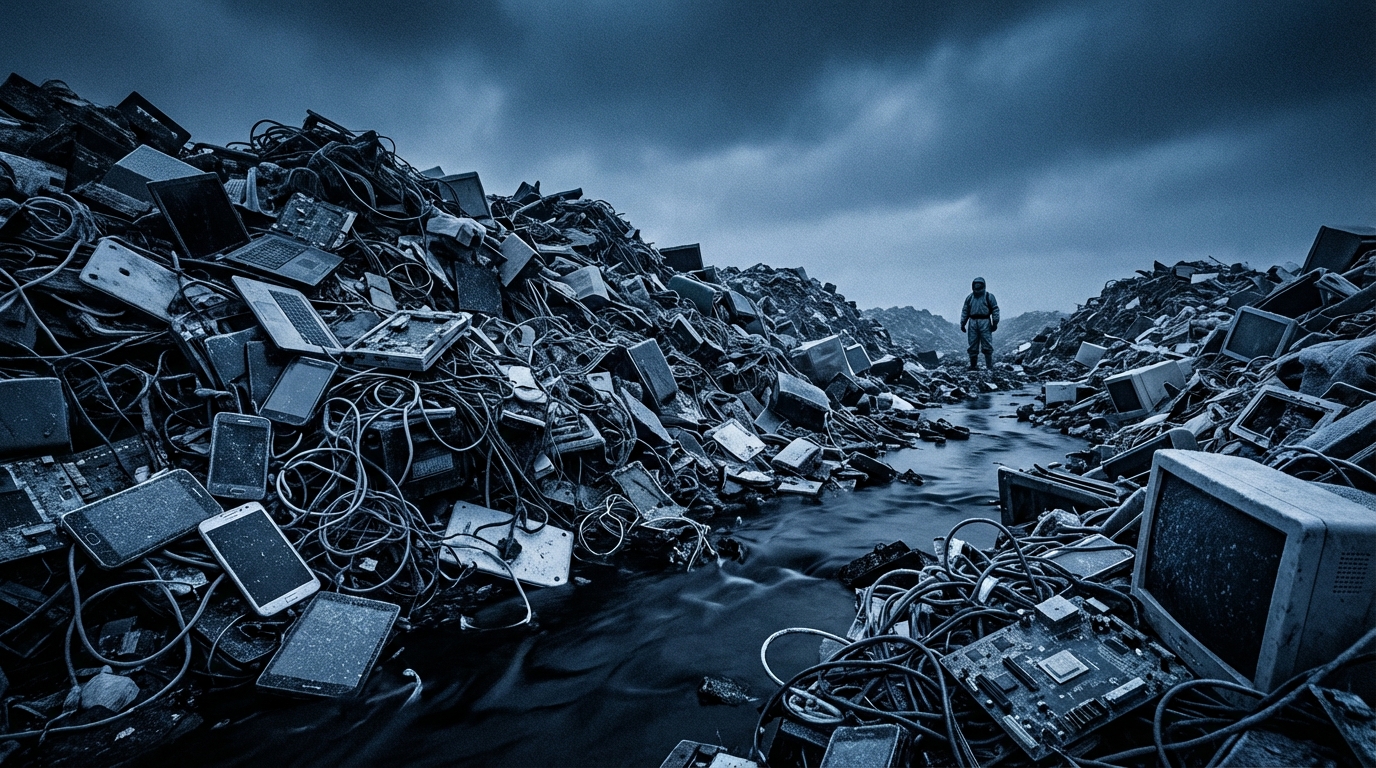

Most people think their old phone “goes away” when they trade it in or drop it at a recycling box. It does not. It turns into someone else’s problem, usually in a country they will never visit, handled by hands they will never see, under conditions they would not accept for themselves.
The short answer: E-waste is the physical fallout of our digital habits. Every server, router, smartphone, and “smart” light bulb is a future waste object loaded with metals, plastics, and toxins. If you care about tech, then you need to care about where your gear ends up and how long you keep it in service. The most effective moves are brutally simple: buy fewer devices, keep them longer, pick repairable hardware, and push vendors that support long-term updates and real recycling instead of greenwashing trade-in schemes.
What E-Waste Actually Is (Not the PR Version)
E-waste is any discarded electronic or electrical equipment: laptops, data center gear, TVs, phones, smart home junk, networking gear, toys with chips, IoT sensors, cables, chargers. If it has a circuit board, a battery, a screen, or a motor, it will eventually join the pile.
E-waste is not “virtual.” It is concentrated metal, plastic, glass, chemicals, and rare materials that have to go somewhere when we are done with the device.
Here is what e-waste physically contains:
- Metals: copper, aluminum, steel, gold, silver, palladium, tin, nickel, cobalt
- Plastics: casings, insulation, connectors, often with flame retardants
- Glass and ceramics: screens, CRT glass in older gear, components
- Hazardous substances: lead, mercury, cadmium, brominated flame retardants, PFAS in some parts, and assorted solvents from manufacturing
- Rechargeable batteries: lithium-ion, lithium polymer, older NiCd and NiMH packs
The problem is not just volume. It is the mixture. Mixed materials make recovery hard and expensive. That is why most “recycling” in practice is low-tech manual sorting, burning, acid baths, and dumping what nobody can profit from.
The Numbers: How Much E-Waste Are We Actually Talking About?
Global e-waste is measured in tens of millions of tonnes per year and rising. The number grows every time someone replaces a functioning smartphone after two years or rips out “old” servers that are merely less power-efficient than the new line.
A simple way to think about it:
| Device Type | Average Lifespan in Use | Typical E-Waste Outcome |
|---|---|---|
| Smartphone | 2 to 4 years | Resale, then informal recycling or landfill |
| Laptop | 4 to 7 years | Refurbished, then parts harvesting, then scrap |
| Consumer router/switch | 3 to 6 years | Stored in a box, then dumped as mixed e-waste |
| Data center server | 3 to 5 years in primary use | Secondary markets, then industrial recyclers |
| Smart home device | 2 to 5 years | Rapid obsolescence, often trashed with cables |
Short lifespans plus billions of devices give you a constant stream of discarded hardware.
Where E-Waste Actually Goes
The fantasy is that you drop a phone in a branded recycling kiosk and a high-tech plant recovers every gram of material. The reality is more fragmented and less pleasant.
Most e-waste flows through a chain of intermediaries: local collection, brokers, exporters, informal recyclers, scrap yards, and landfills. Each link tries to extract value; nobody wants the remainder.
Formal vs Informal Recycling
- Formal recycling facilities use shredders, mechanical separation (magnets, eddy currents, density separation), and controlled smelting. These plants cost money to build and run. They focus on higher value streams and larger volumes.
- Informal recycling is people working with basic tools and minimal protection: hand-dismantling boards, burning cables to expose copper, soaking components in acid to recover gold, dumping residues in open ground or waterways.
Exported e-waste tends to end up with the second category. Even when regulations exist on paper, enforcement is patchy and there is money to be made by bending the rules.
“Recycling” vs Downcycling vs Dumping
A lot of what is called recycling is really downcycling or controlled dumping.
| Process | What Happens | Outcome |
|---|---|---|
| Material recovery | Metals and some plastics are recovered as industrial feedstock | True recycling, but only for a fraction of the material |
| Downcycling | Mixed plastics turned into low-grade products (e.g. benches, pallets) | Delays disposal, does not remove the material from the chain |
| Incineration with energy recovery | Waste burned, some energy captured, ash and toxic outputs managed or leaked | Managed destruction with side effects |
| Landfill | E-waste buried, sometimes in lined sites, sometimes not | Long-term leakage of metals and chemicals |
When vendors talk about “responsible recycling,” they rarely show you the full chain. Often the brand contracts a recycler, the recycler contracts an exporter, and the path disappears at the port.
The Physical and Human Cost
E-waste is toxic for two main reasons: what is already inside the device and what people do to that device when trying to salvage value.
Toxins in E-Waste
There is no way to make a modern electronic device from “friendly” material only. You can reduce the worst substances, but not eliminate risk. Common hazards include:
- Lead in older solder and some glass; it affects the nervous system.
- Mercury in some older lighting, switches, and displays.
- Cadmium in batteries and some chip packages; toxic to kidneys and bones.
- Brominated flame retardants in plastics; they can persist in the environment and accumulate in bodies.
- Fine particulate matter from burning plastics and circuit boards.
When workers burn cables in open pits, they get the metal. The community gets the smoke, ash, and residue for years.
Informal Recycling Communities
In many export destinations, e-waste becomes both an income source and a local environmental disaster. Typical patterns:
- Children and adults pick through piles of discarded hardware.
- Plastic insulation is burned off wires to collect copper.
- Boards are broken, heated, or treated with basic acid mixtures to leach out gold and other metals.
- Residues go into the nearest ditch, river, or soil.
Health effects are predictable: respiratory problems, skin conditions, higher levels of heavy metals in blood, long-term impacts that rarely make it into official statistics.
How Our Digital Habits Feed the Pile
E-waste is not an accident. It is a design choice and a business model.
Short Product Cycles and Artificial Obsolescence
Vendors push frequent hardware upgrades and tie them to software and service changes. Common patterns:
- Software support cutoffs: Operating system updates stop after 3 to 5 years, even when hardware is usable for longer.
- Battery wear: Non-replaceable batteries degrade, making devices annoying before the rest of the hardware is worn out.
- Connector churn: Changing ports and cables turns older peripherals into junk or niche items.
- Cloud lock-in: Devices depend on vendor servers; when service shuts down, hardware is bricked.
When a device stops receiving security patches or server support, it turns into e-waste the moment you can no longer safely connect it.
Marketing Hype and Feature Creep
Incremental updates framed as major leaps push people into early replacements. Better camera, slight performance bump, a new “Pro” badge, some cosmetic tweak. For infrastructure, it shows up as “refresh cycles” and pressure to standardize on new generations.
The issue is not progress itself. The issue is disconnect between real need and replacement timing. Many workloads do not need yearly hardware refresh. Many users do not need a new phone every contract cycle.
The Hidden Side of “Smart Everything”
Every “smart” bulb, speaker, thermostat, or sensor comes with:
- A board with a radio (often Wi-Fi or Zigbee), flash, and a microcontroller.
- A power supply and casing.
- Firmware that may or may not be updated long-term.
When a vendor discontinues a product line or shuts a cloud service, the entire installed base becomes orphaned hardware. Smart home gear has a fast track from “modern” to “brick.”
Web Hosting, Data Centers, and E-Waste
People like to talk about the energy footprint of data centers. The hardware footprint is just as real.
What Happens to Retired Servers and Network Gear
A typical lifecycle inside a serious hosting or cloud environment looks like this:
- 3 to 5 years in primary production roles.
- Possibly a second life in less demanding roles or lower-tier customers.
- Asset disposal: resold to brokers, sent to refurbishers, or handed to contracted recyclers.
Data center gear is at least handled in larger batches, which improves the odds for reasonably managed recycling. The problem is scale and velocity: every generation has more nodes, more switches, more storage enclosures.
Refresh Cycles vs Actual Need
Here is where the cynicism is justified. Vendor sales teams strongly prefer short refresh cycles. They will frame it as reliability, power savings, and performance. Some of that is valid. Power-hungry older servers can be worse for energy and cost than a new generation.
The part that often gets ignored is:
| Factor | Short Cycle (3 years) | Longer Cycle (5 to 7 years) |
|---|---|---|
| Capex pressure | Higher, more frequent | Lower peak, spread out |
| E-waste generation | High, frequent disposal events | Lower over time for same workload |
| Power savings from new gear | Larger relative difference | Incremental |
| Operational risk | Lower age-related hardware failures | Needs better spares and monitoring |
The rational approach is not “always refresh early” or “never refresh.” It is to model total cost of ownership including energy, maintenance, and e-waste impact, then run hardware as long as it stays reliable and supported without huge energy penalties.
Colocation vs Hyperscale Clouds
Hyperscale providers have more leverage to:
- Standardize hardware designs for easier disassembly.
- Run dedicated internal refurbishment and asset recovery programs.
- Negotiate with specialized recyclers.
Smaller hosting providers often depend on general-purpose recyclers and brokers. That does not mean their hardware is doomed, but it does mean they have less direct visibility. Asking hosting vendors how they handle retired gear is not a naive question. It is basic due diligence.
If a hosting provider has no clear answer on where their retired servers go, then they are outsourcing the problem and hoping nobody asks.
The Strange Afterlife of Your Personal Tech
For individuals, e-waste rarely feels immediate. You relegate the old laptop to a closet “just in case” and forget it. Multiply that hesitation by millions of people and you get a storage layer of dormant e-waste sitting in drawers and boxes.
Trade-In Programs and Buy-Backs
Phone and laptop trade-in programs are marketed as clean solutions. The fee you get back is real. The environmental benefit is mixed.
Typical flows:
- Recent, undamaged devices: refurbished, resold in secondary markets.
- Older but functional devices: harvested for parts, maybe resold as low-end stock.
- Damaged or obsolete units: bulk scrap, with some elements recovered.
Refurbishment extends lifespans, which is good. The catch is that trade-in incentives also keep upgrade churn going. They reduce friction to replace a workable device early.
DIY Recycling vs Official Channels
Breaking devices apart at home for “recycling” is a bad idea. You expose yourself to dust, residues, and sharp metal, and you end up with smaller mixed waste piles that still go to normal trash.
Preferred approach:
- Use certified e-waste collection centers or municipal programs.
- Ask what they do with the material, not just where to drop it.
- For batteries, use dedicated battery bins or programs.
Storing old gear “until later” only delays the problem. If a device is not going to be used again, it is better to send it into a recycling stream while it still has parts value.
Right to Repair and Design Choices
Right to repair is not just about saving money on a screen replacement. It is directly tied to e-waste volume.
Repairability vs Landfill
When hardware is built with glued batteries, proprietary screws, sealed cases, or paired components, repairs become expensive or impossible. At that point, many users will replace rather than fix.
Every non-replaceable battery is a built-in expiration date that turns working electronics into trash when chemistry ages out.
Good design from an e-waste perspective looks like this:
- Standard screws and fasteners, not glue walls.
- Easily accessible battery modules.
- Modular parts: storage, RAM, and some ports on replaceable boards.
- Clear documentation and spare parts availability.
On the server side, things are often better: hot-swappable drives, modular PSUs, standard racks. Consumer tech often does the opposite for cosmetic reasons.
Firmware and Software Support
A device is only as live as its software support. When vendors stop issuing patches or block alternative firmware, hardware is cut off early.
Positive examples include:
- Phones that receive security updates for 5 years or more.
- Routers with open firmware ecosystems that stay maintained.
- Laptops with long-term BIOS/UEFI updates and open OS support.
Negative examples:
- IoT devices locked to expired cloud services.
- Printers that refuse third-party consumables and then lock out after a firmware push.
- Hardware with signed bootloaders that block community firmware, even when the vendor drops support.
When buying gear, long-term support promises should matter as much as headline specs.
Digital Communities, Platforms, and E-Waste Pressure
Online communities, especially tech-focused ones, influence buying habits. That influence can increase or reduce e-waste.
Spec Culture and Upgrade Bragging
Forums, subreddits, and Discords often treat rapid upgrading as a status symbol:
- Yearly GPU replacements for marginal gains.
- Phone upgrade threads framed as default behavior.
- Build logs that treat previous builds as disposable.
Nobody in those threads talks much about what happens to last year’s “beast” system. Often it is passed along, which is better than landfill, but this culture still pushes overbuying and short cycles.
Community Initiatives that Actually Help
Digital communities can also support better patterns:
- Repair clubs and guides.
- Hardware lending or sharing pools.
- Used gear marketplaces with reputations and testing standards.
- Public teardown and repairability reviews that penalize glued objects.
If you are part of a tech community, you can shape norms: celebrate long-lived rigs and stable servers instead of constant replacement.
What You Can Do as a Tech User
For individuals, the realistic moves are not glamorous. They are small, boring decisions repeated over years.
Buying Hardware
When you pick new gear, treat e-waste impact as a spec:
- Durability: Solid build, not fragile casing that cracks at the first bump.
- Repairability: Check teardown scores, look for replaceable batteries and parts.
- Support horizon: Clear, long OS and firmware update timelines.
- Standard parts: Upgradable storage and RAM when possible.
Skip “disposable” gadgets. A cheap smart scale that loses cloud support in two years is not cheap if it goes straight to e-waste.
Using and Maintaining Devices
Choices during the life of the device matter:
- Use protective cases and screen protectors to extend physical life.
- Replace batteries instead of replacing entire devices when feasible.
- Keep firmware and OS updated to stay secure without new hardware.
- Avoid unnecessary stress like constant fast charging when it dramatically shortens battery lifespan.
Captain Obvious advice, but ignored daily.
End of Life Handling
When a device truly reaches the end of its usable life for you:
- Wipe data securely.
- Offer it to someone who can use it if it is still functional.
- If not, send it to a reputable recycling channel, not general trash.
Ask local authorities or electronics retailers about certified collection points. If the staff cannot explain what happens next, be skeptical and push for better transparency.
What You Can Do as a Developer, Admin, or Operator
If you run servers, manage infrastructure, or influence procurement, you shape a larger e-waste footprint than a single consumer.
Designing Services and Architectures
Software decisions affect hardware churn:
- Write and select software that runs well on older hardware, not just the latest CPUs.
- Avoid needless feature bloat that drives resource requirements through the roof.
- Use capacity planning so you do not overprovision clusters “just in case” forever.
Lightweight, well-architected services extend hardware life.
Hardware Procurement and Lifecycle Policies
Set policies that make sense instead of blindly following vendor refresh templates:
- Define minimum support lifespans for servers, networking equipment, and storage.
- Negotiate contracts that include responsible end-of-life handling with evidence, not marketing lines.
- Keep a parts stock for minor repairs instead of rotating whole units at the first issue.
Track asset lifecycles with real data: failure rates, repair metrics, power usage. Use that data to decide when hardware is genuinely at the end of its economical or technical life.
Choosing Hosting and Cloud Providers
If you buy hosting:
- Ask providers how long they keep hardware in production.
- Ask what happens to retired hardware and if there are refurbishment stages.
- Support providers that publish sustainability and e-waste handling reports with specifics, not slogans.
You will not get perfection. You can still reward those at least moving in the right direction.
Policy, Regulation, and Greenwashing
E-waste is not just a personal or company-level issue. It is tied to how laws are written and how brands market themselves.
EPR and Compliance Labels
Extended Producer Responsibility (EPR) laws try to make manufacturers responsible for the fate of their products after sale. Implementation quality varies widely, but the principle is straightforward: if you sell it, you help collect and recycle it.
Compliance labels and take-back schemes exist, but:
- They often cover only a fraction of total product volume.
- They can rely heavily on export, shifting the problem geographically.
- Data is often self-reported, with little external verification.
Spotting Greenwashing
Brands like to talk about “carbon neutral,” “recycled materials,” and “earth-friendly” lines. Some of that is useful. A lot of it is surface-level.
Red flags:
- Big claims with no detailed breakdown of recycling rates and methods.
- Emphasis on packaging changes while device lifecycles stay short.
- Trade-in pushes without reporting on the fate of returned devices.
A phone with a “recycled aluminum” frame that gets two years of support still becomes e-waste in record time.
Look for concrete actions: extended software support, broad right-to-repair compliance, transparent end-of-life reporting, design changes that simplify disassembly.
Accepting Tradeoffs Without Looking Away
Digital life has a physical cost. Servers sit in real buildings, phones contain mined materials, and “cloud” data lives on boards that will age and fail.
The point is not to stop buying hardware or to feel guilty about every router. The point is to stop pretending that our devices disappear when we are done with them.
Thinking like a veteran user or operator means:
- You question upgrade cycles instead of accepting them as law.
- You treat repairability and support as core specs, not footnotes.
- You push vendors, communities, and employers to take end-of-life handling seriously.
We built a digital world out of physical objects. E-waste is the bill. How large that bill becomes depends on what we buy, how long we run it, and what we demand from the people who sell it to us.